
Thinking about a change? Perhaps you're ready to take that next step for yourself and your family but aren't quite sure where to start. Finding the right online course can feel like a huge decision, but it's much simpler when you know the secret: accreditation.
Think of accreditation for online courses as your quality guarantee—it’s the official stamp that proves a qualification is trusted, valuable, and recognised by UK employers.
What Accreditation for Online Courses Really Means for You
Let's be honest, the word ‘accreditation’ can sound a bit formal. But what it really means for your future is straightforward and incredibly important.
Think of it this way: when you buy a new phone or a car, you look for a trusted brand name or an official stamp of approval, right? You want to know you’re getting the real deal. Accreditation is exactly that, but for your education. It’s a process where an independent, official body checks that a course and its provider meet a high standard of quality.
This thorough check ensures a few key things:
- The course content is accurate, relevant, and fully up-to-date.
- The tutors and support team are properly qualified and ready to help you succeed.
- The qualification you earn is genuine and has real value in the workplace.
In the UK, this process is often overseen by government-approved organisations, giving you complete peace of mind that your hard work will pay off.
Learning as an Adult is Your Superpower
If school wasn't the best experience for you, the idea of returning to education might feel a little nerve-wracking. But here's the brilliant news: learning as an adult is a completely different world. It’s not about sitting in a stuffy classroom or being talked at.
Online learning is about feeling empowered. It’s about fitting education around your life, your family, and your personal goals. You are in the driving seat, and a properly accredited course is your map to a better future.
This is your chance to prove to yourself, and everyone around you, just what you are capable of. It’s about gaining the knowledge and confidence to go for that promotion, switch to a career you’re truly passionate about, or boost your earnings for good.
A Powerful Step Towards a Brighter Future
Choosing an accredited online course is so much more than just getting a certificate. It’s a powerful statement about your ambition and your commitment to building a better life for yourself and your loved ones. Just imagine the pride you’ll feel when you achieve your qualification, knowing you’ve made a solid investment in yourself.
This is your opportunity to become a fantastic role model for your children and family, showing them what can be achieved with determination. By choosing a properly accredited path, you’re not just learning a new skill; you’re unlocking a door to a future with higher earnings, better job security, and the amazing feeling of knowing you did it.
How Accreditation Can Open Doors to a Better Career
Finishing a course and earning a new qualification is a fantastic feeling. But when that qualification is officially accredited, it becomes something more—it’s a recognised stamp of approval that can genuinely change your career and your future.
Think of it like this: an accredited qualification is something UK employers immediately understand and value. It tells them you have met a national standard of quality, proving you have the skills and knowledge that matter in the real world. This isn't just about getting a certificate; it’s about earning the professional respect you’ve worked so hard for.
For many adults returning to learning, this recognition is huge. It quiets any self-doubt and proves you didn’t just do a course—you achieved something with real substance and credibility.
Boosting Your Pay Packet and Career Path
Let’s be honest, one of the biggest reasons for learning new skills is the chance to earn more. When you have a properly accredited qualification on your CV, you stand out. You’re no longer just another applicant; you’re a candidate who has proven their commitment and ability.
For many people, gaining an accredited qualification is the single most effective step they take towards a significant pay rise. It gives you the confidence to apply for better jobs or ask for a better salary, knowing your skills are officially recognised.
This opens up some brilliant new possibilities:
- Career Advancement: That promotion you’ve been aiming for? An accredited course can be the very thing that helps you get it.
- New Industries: It gives you the credible foundation you need to move into a field you’re truly passionate about.
- Higher Earning Potential: Employers are more willing to invest in people with qualifications they know and trust, which often leads directly to a better salary.
This isn't just about a number on a payslip. It's about the freedom to provide more for your family, the security of a healthier bank balance, and the immense pride that comes from seeing your hard work pay off.
Becoming a Source of Pride and Inspiration
Think about the moment you get to tell your family you’ve passed. Choosing to go back to learning takes courage, and seeing it through is a massive achievement. You instantly become a role model for your children, showing them firsthand that it’s never too late to learn something new and improve your life.
Your success tells a story of ambition and determination. It proves that when you put your mind to it, you can achieve your goals, creating a positive ripple effect that inspires everyone around you. It’s an achievement you can be incredibly proud of. The journey of Abbie, who secured her dream job after facing her own challenges, is a fantastic real-world example of what’s possible. You can explore how Abbie's story unfolded on our blog.
The proof is in the numbers, too. Searches for 'online courses' in the UK surged over 200% between 2019 and 2021 as more people realised their value. More importantly, around 80% of UK online learners reported getting a promotion or a new job within six months of finishing an accredited course. This shows just how much employers value these qualifications. You can learn more about these online education statistics and see the impact for yourself.
Understanding the UK's Official Awarding Bodies
Now that we know just how important proper accreditation is, let's look at the official ‘quality controllers’ of UK education. Knowing who these organisations are gives you the power to spot a genuine, life-changing course from a mile away.
Think of it as a system of checks and balances designed to protect you. You have a main government referee, and then you have the organisations that design and award the qualifications themselves. It's a structure that guarantees your hard work will be recognised and respected.
The Government's Quality Referee: Ofqual
The first and most important name to remember is Ofqual, which stands for The Office of Qualifications and Examinations Regulation. Ofqual is a non-ministerial government department that regulates qualifications, examinations, and assessments in England.
Basically, Ofqual doesn't create courses or hand out certificates. Its job is to set the rules of the game for everyone else. It makes sure that every regulated qualification is reliable, consistent, and trusted right across the country. When you see a course is "Ofqual-regulated", that’s your gold-standard guarantee of quality.
The Qualification Designers: Awarding Organisations
So, if Ofqual is the referee, who are the players? These are the Awarding Organisations, sometimes called Awarding Bodies. They are the expert bodies approved and monitored by Ofqual to design, develop, and ultimately award qualifications.
You’ll likely recognise some of the big names here:
- AQA: A leading provider of qualifications like GCSEs and A-Levels.
- Pearson (Edexcel): Another major body offering a huge range of academic and vocational qualifications.
- NCFE / CACHE: Well-known specialists in vocational and technical learning, particularly in sectors like health and social care.
When you enrol in an accredited online A-Level, for instance, your course provider (like Lifelong Learning College) delivers the teaching and support. However, the final qualification certificate comes from one of these official awarding bodies. This is what ensures your A-Level holds the exact same weight and respect whether you studied it online or in a traditional college.
This simple diagram shows how that powerful connection works in practice, leading from a quality course to a brighter future.
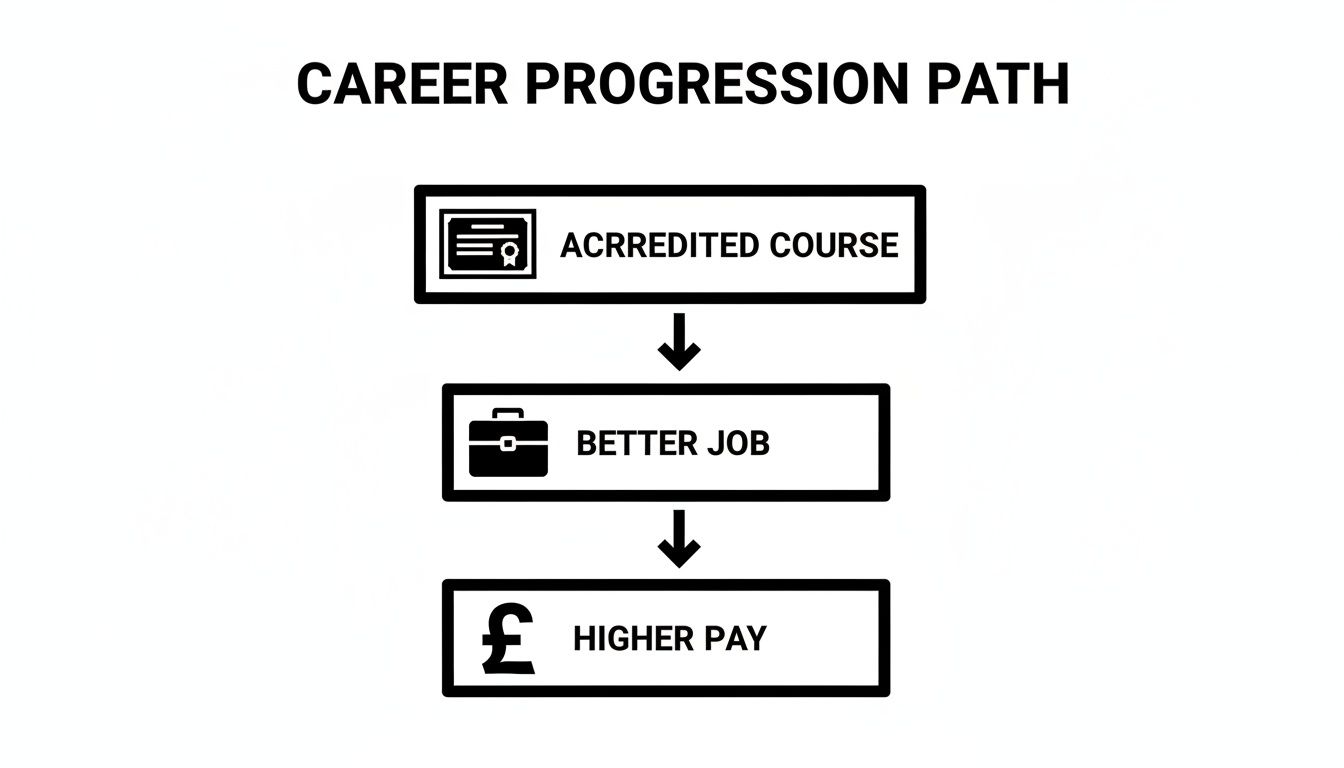
It’s a clear path. Choosing a properly accredited course isn't just a detail—it's the first and most vital step towards better jobs and higher earning potential.
Ensuring University-Level Quality
But what about courses that are a direct stepping stone to university? For qualifications like the popular Access to Higher Education Diplomas, another key player enters the picture: the QAA (Quality Assurance Agency for Higher Education). The QAA is the independent body that checks whether UK higher education courses meet the high standards expected, giving you confidence that your diploma is a trusted route to a university degree.
This system of regulation is your safety net. It means you can invest your time and money into your education with complete certainty, knowing the qualification you earn will open doors, not close them.
For example, the Royal Statistical Society's accreditation scheme is a perfect illustration of how these quality frameworks operate, ensuring UK online courses meet strict benchmarks like those set by the QAA. It’s part of a growing trust in regulated online learning, a sector that saw 404,140 learners enrol in Level 3 qualifications alone in 2026. These systems ensure providers like Lifelong Learning College offer courses that hold real value for getting into university and impressing employers. You can read more about these quality frameworks on the RSS website.
How to Check if an Online Course Is Properly Accredited
So, you're ready to take the next step in your career or personal development. That's brilliant. But with so many online courses out there, how can you be sure you're choosing one that’s genuinely worth your time and money?
Think of it like buying a house. You wouldn't invest without first checking that it has solid foundations and has been properly inspected. We're going to apply that same common-sense approach to your education. This isn't about being negative; it's about being a smart learner who knows how to spot the real deal.
Your Step-by-Step Checklist
When you land on a course provider’s website, doing a quick quality check is easier than you think. Good providers are proud of their partnerships and will have this information clearly displayed.
- Look for the Logos: First, scroll down to the bottom of the homepage. You should be able to spot the logos of their official partners. The most important one is Ofqual, the UK government's own regulator. You should also see the logo of the specific Awarding Organisation (like AQA, Pearson, or NCFE) that officially grants the qualification.
- Read the 'About Us' Page: This is often where a provider tells their story. A trustworthy college will be upfront about their commitment to providing regulated qualifications and will name the awarding bodies they partner with. No vague promises, just clear facts.
- Check the Course Description: Every regulated course page must state which Awarding Organisation validates it. For instance, you should see a clear statement like, "This A-Level in Psychology is awarded by AQA." If that detail is hidden or missing, it’s a sign to dig a little deeper.
Using the Official Government Register
This next step is your ultimate fact-checker. It allows you to check a qualification's legitimacy for yourself, giving you complete peace of mind. The UK government maintains a fantastic tool called the Register of Regulated Qualifications.
Here’s how to use it:
- Go to the official government register website.
- In the search bar, type in the exact title of the course you're considering (e.g., "A-Level Biology").
- The search results will show you a definite list of all the Awarding Organisations approved to offer that specific qualification.
If a provider claims their course is awarded by an organisation that doesn't appear on that official list, you've spotted a problem. This simple check takes just a few minutes and puts you firmly in control.
Spotting the Difference: Genuine vs. Misleading
Learning to tell the difference between a truly valuable course and one that just looks the part is a vital skill. It's often a case of being clear versus being confusing. Trustworthy providers are open and clear, while others might rely on confusing language to seem legitimate.
Here’s a quick comparison to help you tell them apart.
Spotting Genuine vs. Misleading Accreditation
| Green Flags to Look For | Red Flags to Avoid |
|---|---|
| Clear Naming: Mentions Ofqual and specific Awarding Organisations (AQA, Pearson, etc.) by name. | Vague Language: Uses fuzzy terms like "independently accredited" or "fully certified" with no specific body mentioned. |
| Publicly Listed: The course and provider appear on the official Register of Regulated Qualifications. | Missing Details: You can't find the name of the Awarding Organisation or a Qualification Number anywhere. |
| Transparent Information: The provider's website clearly explains its accreditation status and processes. | High-Pressure Sales: You're pushed to enrol with "flash sales" or "last-chance" offers that create false urgency. |
| Focus on Quality: The emphasis is on the educational standard, curriculum, and the value of the final qualification. | Guarantees of Success: Makes unrealistic promises about guaranteed jobs or instant success after completion. |
By keeping these signs in mind, you can look at your options with confidence. A good provider wants you to be informed. For example, we believe it's important that you understand how our own processes work and what you can expect from us every step of the way.
Checking a course isn't about being suspicious; it's about respecting yourself. It’s a simple action that protects your investment and ensures the certificate you earn will be a powerful and respected tool for your future.
Every officially regulated qualification in the UK is given a unique Qualification Number. If a provider is hesitant or unable to share this number with you, it is a very strong sign that the course is not government-regulated.
With this checklist, you have everything you need to choose a course that will genuinely help you build a better, brighter future for yourself and your family.
How We Guarantee Your Success with Accredited Learning
So, we've talked a lot about what accreditation for online courses means and why it’s so crucial for your future. Now, let’s show you how we, at Lifelong Learning College, live and breathe these standards to help you get where you want to go. We don't just tick boxes; we've built our entire college around genuine quality.
Our promise is simple: every single qualification we offer is officially regulated and recognised. This gives you a clear, trusted path forward. We know that coming back to education is a big decision, especially when you’re juggling a job, family, and everything else life throws at you. That’s why we’ve made sure our learning experience isn't just credible, but also supportive and truly empowering.
You’ve decided you want more for yourself, and we’re here to give you the tools to make it happen. Earning a qualification with us is about more than just a piece of paper—it’s about building your confidence, boosting your earning potential, and becoming a source of pride for you and your family.
Our Commitment to Officially Regulated Qualifications
Here at Lifelong Learning College, we only partner with the UK's most respected Awarding Organisations. Why? Because it means the qualification you earn with us has real weight. It's the very same certificate a student would receive at a physical college, ensuring it’s valued by universities and employers right across the country.
Our main qualifications come from these official, trusted bodies:
- A-Levels are awarded by AQA and Pearson Edexcel, two of the biggest and most established names in UK education.
- GCSEs are also awarded by AQA and Pearson Edexcel, giving you a solid foundation for your next steps.
- Access to Higher Education (HE) Diplomas are awarded by respected bodies like AIM, providing a well-trodden path to university.
Every one of these qualifications is regulated by Ofqual. This is your absolute guarantee that your hard work will result in a qualification that is nationally recognised, credible, and a powerful tool for opening doors to new opportunities.
This focus on regulated learning is more important than ever. UK government data shows a clear demand from adults for credible qualifications. In the 2026 academic year, there were hundreds of thousands of enrolments in regulated further education courses. While Level 2 courses were popular, participation in Level 3 courses—which are vital for getting into university—rose by 3.0%. For providers like us offering accredited A-Levels and Access to HE Diplomas, this shows a strong and ongoing demand from adults seeking real pathways to advance their education. You can discover more insights about further education trends on the official UK government statistics site.
Support Designed for Adult Learners Like You
We know that success isn't just about the qualification at the end; it's about the journey you take to get there. Perhaps school wasn't a great experience for you the first time around—that’s okay. This is completely different. We’ve helped thousands of adults just like you reach their goals, and we truly understand the unique challenges you face.
From the moment you enrol, you're not just a number. You’re part of a community that’s cheering you on. You’ll be backed by a dedicated team of people who are there to help you every step of the way. You can learn more about the dedicated support our expert tutors provide and see exactly how they help you succeed.
Our courses are designed to be flexible, so you can study at your own pace and fit learning around your life, not the other way around. You can finally go after that qualification you’ve always wanted without putting your career or family life on hold. It’s your time to shine, and we're here to make sure you have everything you need to do it.
Your Questions About Course Accreditation Answered
Thinking about taking an online course is exciting, but it’s natural to have a few questions. In fact, it's smart. Knowing exactly what you’re signing up for is the best way to feel confident about your next step.
We get asked about accreditation all the time, so we’ve put together some straight-talking answers to the questions we hear most from adult learners. Let’s clear up the confusion so you can choose a course with total peace of mind.
Is There a Difference Between an Accredited Course and a Regulated Qualification?
Yes, a huge one. This is probably the single most important thing to understand when you’re looking at accreditation for online courses. The terms sound similar, but they aren’t the same.
An ‘accredited’ course just means a professional body has reviewed it and given it a thumbs-up. That’s a good start, but the value of that approval depends entirely on who the body is. Some are well-respected, but others carry very little weight with employers or universities.
A ‘regulated qualification’, however, is the gold standard. This means the qualification is officially recognised by a UK government regulator, like Ofqual. Qualifications like A-Levels, GCSEs, or an Access to HE Diploma all sit on this national framework.
Think of it like a car’s MOT. An ‘accredited’ check could be a local garage saying they’ve had a look. A ‘regulated’ MOT, on the other hand, is done by a government-approved test centre following strict, national standards. When it comes to your education, you want that government-backed guarantee.
Choosing a regulated qualification gives you a 100% guarantee that it will be accepted and understood by universities and employers across the UK. It’s simply the safest bet for your future.
Will Employers Really Value an Online Qualification?
This question comes up a lot, and the answer is a firm yes—as long as the qualification is properly regulated.
Employers today care about the quality and standard of your skills, not where you learned them. An Ofqual-regulated qualification is a national standard; it holds the exact same value whether you earned it in a traditional classroom or from your kitchen table.
In fact, many employers see online learning as a real plus. It proves you have a set of brilliant skills that are valuable in any role:
- Self-Discipline: You’ve shown you can manage your own schedule and stay on track without constant supervision.
- Time Management: Juggling your studies with work, family, and life shows incredible organisational skills.
- Commitment: It shows a powerful drive to grow and improve yourself—a quality every employer wants on their team.
Finishing an online qualification tells an employer you’re ambitious, organised, and ready to get things done. It’s a modern way of learning that earns modern respect.
What if a Course Says It Is Independently Accredited?
This is where you need to put your detective hat on. You’ll see phrases like “independently accredited,” “fully certified,” or “endorsed by our own internal board.” They sound official, but they're often a red flag that the course isn't regulated by Ofqual.
Some providers essentially accredit themselves or partner with organisations that aren't recognised by the UK government. While the course material might be interesting, the certificate you get at the end comes with a big risk.
That qualification might not be recognised by:
- Universities for entry onto a degree course.
- Professional bodies if you need a licence to practise.
- Employers who are looking for nationally recognised qualifications.
If your course is a stepping stone to university or a specific career, sticking to nationally recognised Awarding Organisations and Ofqual-regulated qualifications is the safest and most valuable path. It protects your investment of time and money, ensuring the certificate you earn actually opens the doors you want it to.
Can I Still Get Support if I Study Online?
This is a really common worry, especially for anyone who felt unsupported at school in the past. The thought of studying alone can be daunting, but a great online college is built completely around student support.
You are never just left to get on with it. From dedicated, expert tutors who can explain tricky subjects to student support teams who are there to help with motivation and study skills, the whole experience is designed to help you succeed. This isn't the lonely, old-fashioned distance learning you might be imagining.
Modern online education is about connection. It's about having a team of people in your corner, cheering you on and offering expert guidance whenever you need it—all while giving you the flexibility to live your life.
This support system makes sure you feel capable and confident from start to finish. It’s all about empowering you to achieve something brilliant for yourself and your family.
Feeling inspired and ready to make a change? At Lifelong Learning College, all our qualifications are officially regulated, giving you the confidence that your hard work will pay off. Explore our range of A-Levels, GCSEs, and Access to HE Diplomas and start your journey today. Find out more at https://lifelonglearningcollege.com.